Choosing between a 10-yard and a 20-yard dumpster may seem simple. One holds twice as much debris as the other, so renting the larger container should solve the problem, right?
Not necessarily.
A 20-yard dumpster provides more space for bulky waste, but a 10-yard container may be the better choice for smaller projects, limited placement areas, and heavy materials such as concrete or brick.
The right dumpster depends on three things: how much debris you’re removing, how heavy it is, and how much space you have for the container.
This 10 yard vs 20 yard dumpster comparison covers dimensions, capacity, recommended uses, rental costs, loading requirements, and common mistakes so you can choose the right container for your Michigan project.
10-Yard vs. 20-Yard Dumpster: Quick Comparison
The biggest difference between these containers is their volume. A 20-yard dumpster holds twice the cubic-yard capacity of a 10-yard dumpster, but their recommended uses differ depending on the materials being removed.
| Feature | 10-Yard Dumpster | 20-Yard Dumpster |
|---|---|---|
| Capacity | 10 cubic yards | 20 cubic yards |
| Dimensions (L × W × H) | 11′ × 7′ × 3.5′ | 22′ × 8′ × 4.5′ |
| Approximate pickup loads | 3–4 | 6–8 |
| Best for | Small cleanouts, minor renovations, approved heavy debris | Medium cleanouts, remodeling, roofing, mixed construction debris |
| Concrete or all-brick loads | Required container size | Not suitable for all-concrete or all-brick loads |
| Placement space | Smaller footprint | Requires more space |
| Main advantage | Compact and appropriate for smaller or dense loads | Twice the volume for bulkier debris |
Dimensions reflect Rearden Environmental’s container specifications. Pickup-load estimates are general volume comparisons, not guaranteed weight allowances.
Quick recommendation:
- Choose a 10-yard dumpster for smaller cleanouts, single-room renovations, or all-concrete and all-brick projects.
- Choose a 20-yard dumpster for larger household cleanouts, kitchen remodeling, flooring replacement, and approved mixed construction debris.
For a project with dense materials, don’t automatically choose the larger container. Rearden Environmental may direct you to a 10-yard dumpster to manage the weight safely.
Understanding Dumpster Dimensions and Capacity
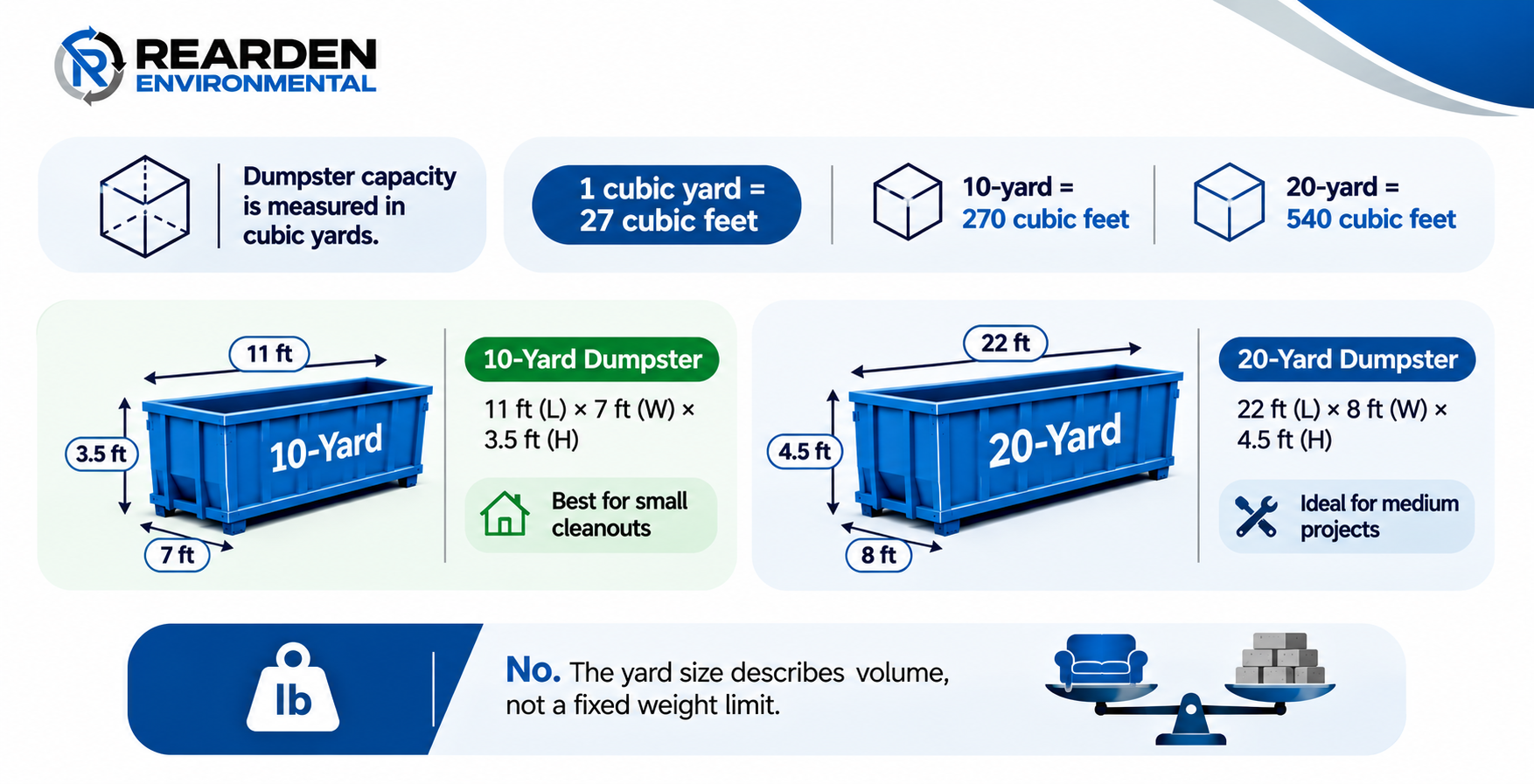
Dumpster capacity is measured in cubic yards, which describe how much space a container holds.
One cubic yard equals 27 cubic feet.
That means:
- A 10-yard container holds approximately 270 cubic feet.
- A 20-yard container holds approximately 540 cubic feet.
Although the larger container provides twice the volume, that doesn’t mean it can carry twice the weight.
How Big Is a 10-Yard Dumpster?
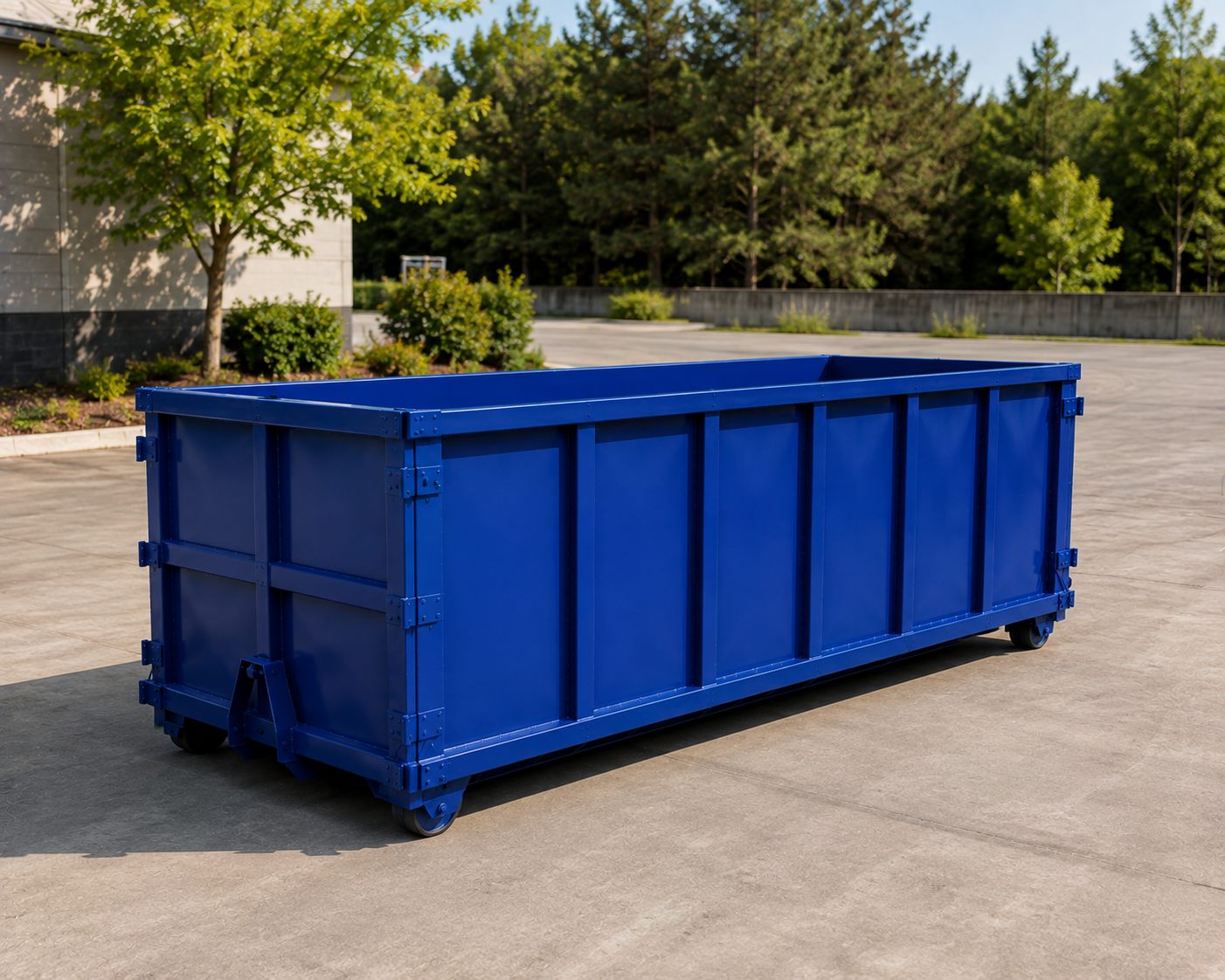
Rearden Environmental’s 10-yard dumpster measures approximately:
11 feet long × 7 feet wide × 3.5 feet high
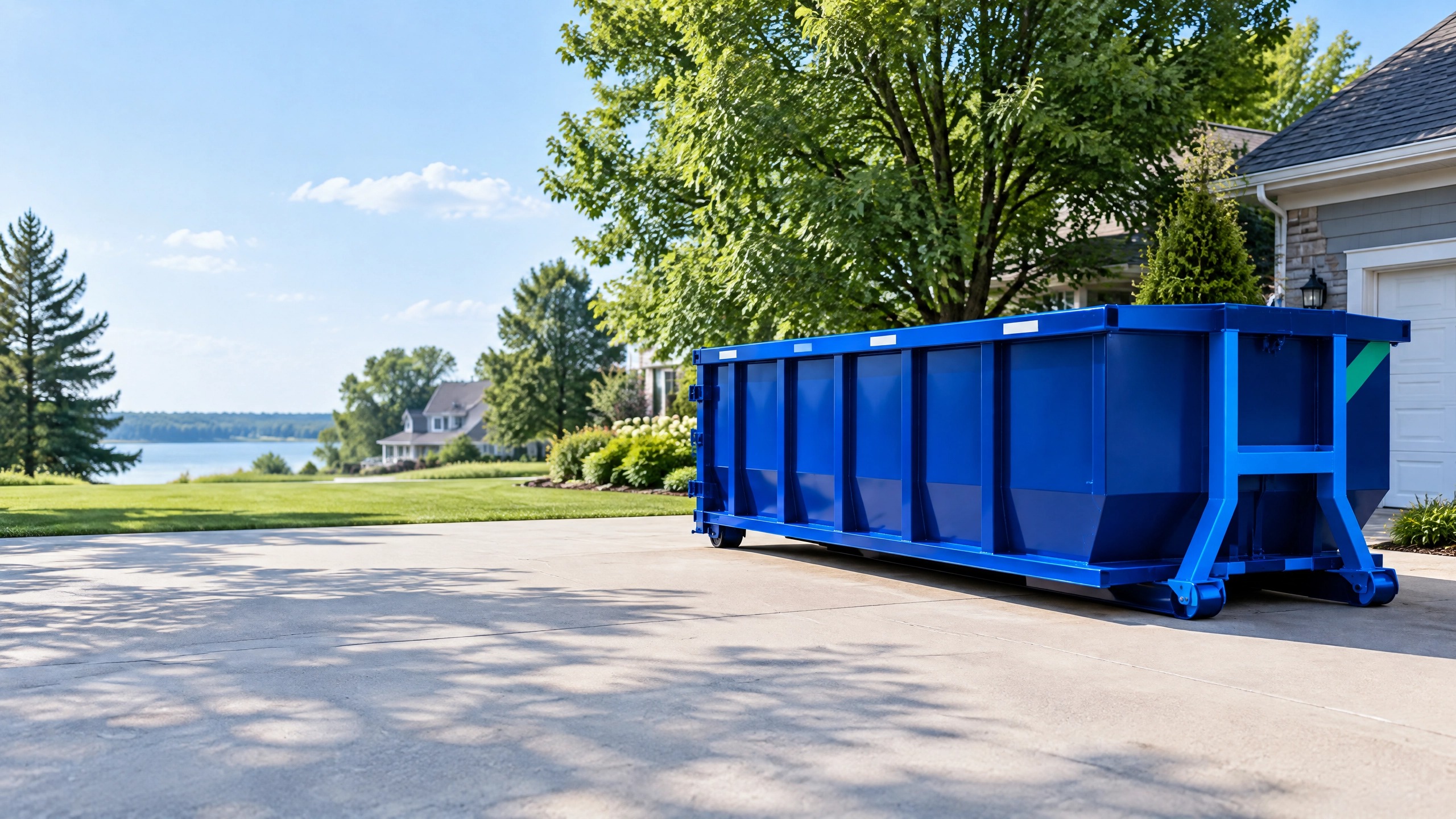
Its compact footprint makes it useful for small residential cleanouts and properties where space is limited.
The lower sidewalls can also make loading smaller items and approved heavy debris more manageable.
For a closer look at dimensions and what fits, read How Big Is a 10-Yard Dumpster?.
How Big Is a 20-Yard Dumpster?
Rearden Environmental’s 20-yard dumpster measures approximately:
22 feet long × 8 feet wide × 4.5 feet high
Compared with the 10-yard option, it’s longer, wider, and taller, providing considerably more room for furniture, flooring, cabinets, and other bulky materials.
This makes it practical for medium-sized home improvement and construction projects.
Explore 20-yard dumpster dimensions and capacity for more details.
Does a 20-Yard Dumpster Hold Twice the Weight?
No. The term 20-yard describes volume, not a fixed weight limit.
Two dumpsters can contain the same volume of debris but weigh very different amounts.
For example, 10 cubic yards of household furniture may weigh much less than 10 cubic yards of concrete.
That’s why dumpster selection must account for the material being disposed of, not just the amount of space it occupies.
10-Yard vs. 20-Yard Dumpster: Which Is Better for Your Project?
The most useful way to compare these sizes is to look at what you’re actually removing.
When Should You Rent a 10-Yard Dumpster?
A 10-yard dumpster is generally suitable for projects that generate a limited amount of waste or involve approved heavy debris.
Common uses include:
- Small garage and basement cleanouts
- Bathroom remodeling
- Single-room flooring removal
- Minor interior demolition
- Small deck or shed removal
- All-concrete and all-brick projects, subject to approved loading requirements
Its smaller dimensions make it a practical option for residential properties with limited placement space.
However, a 10-yard container can fill quickly when removing large furniture or substantial quantities of household junk.
When Should You Rent a 20-Yard Dumpster?
A 20-yard dumpster is often a better choice for medium-sized projects that produce more bulky debris.
Common uses include:
- Kitchen renovations
- Multiple-room cleanouts
- Flooring replacement
- Roofing projects
- Moderate construction and demolition
- Deck removal
- Property cleanups involving furniture and household waste
The additional volume provides more room for irregularly shaped materials such as cabinets, drywall, and lumber.
A small amount of brick mixed with other approved materials may be suitable for a 20-yard dumpster, depending on the total load.
However, all-brick and all-concrete jobs require a 10-yard container.
Dumpster Size Comparison by Project
| Project | Recommended Size | Why |
|---|---|---|
| Small garage cleanout | 10 Yard | Limited household junk and storage items |
| Bathroom renovation | 10 Yard | Usually a smaller volume of demolition debris |
| Kitchen remodeling | 20 Yard | Cabinets, flooring, drywall, and bulky materials |
| Single-room flooring replacement | 10 Yard | Depends on flooring type and quantity |
| Multiple-room flooring removal | 20 Yard | More material and larger debris volume |
| Medium house cleanout | 20 Yard | More space for furniture and household junk |
| Small deck removal | 10 Yard | Suitable for limited amounts of lumber |
| Larger deck demolition | 20 Yard | More room for boards and framing |
| Concrete driveway removal | 10 Yard | Heavy material requires the designated smaller container |
| All-brick demolition | 10 Yard | Weight management and hauling requirements |
| Roofing replacement | 10 or 20 Yard | Depends on roof size, shingle weight, and load requirements |
These are starting recommendations. Actual container selection depends on the amount of debris, material weight, and project conditions.
What Size Dumpster Do I Need for a House Cleanout?
For a small household cleanout, a 10-yard dumpster may provide enough capacity.
A 20-yard dumpster is usually worth considering when you’re removing furniture and belongings from several rooms.
However, house size alone isn’t a reliable measure of dumpster requirements.
A 2,000-square-foot home with limited clutter may generate less waste than a smaller house packed with old furniture and stored belongings.
Choose a 10-Yard Dumpster When:
- You’re cleaning one or two rooms.
- Most waste consists of boxes and smaller household items.
- You’re removing limited furniture.
- You have restricted driveway space.
Choose a 20-Yard Dumpster When:
- You’re clearing several rooms.
- You’re removing couches, tables, cabinets, and carpeting.
- The project includes a moderate amount of renovation debris.
- You expect more waste than a compact container can reasonably hold.
Practical tip: Identify your largest items before estimating the total debris volume.
A couch, several cabinets, and bulky furniture can occupy more space than dozens of small boxes.
Which Dumpster Is Better for Remodeling and Renovation?
Renovation waste can be difficult to estimate because different materials occupy space differently.
Drywall and cabinets are bulky, while tile and masonry can be relatively heavy.
Bathroom Renovations
A 10-yard dumpster may be enough for a single bathroom renovation involving fixtures, drywall, flooring, and a limited amount of debris.
However, projects involving extensive tile or masonry removal require closer attention to weight.
Kitchen Remodeling
A 20-yard dumpster is often more practical for a complete kitchen renovation.
Cabinets, countertops, flooring, and drywall can occupy considerable space, especially when multiple materials are removed together.
Flooring Replacement
For one room, a 10-yard container may be sufficient.
For flooring removal across several rooms, a 20-yard container provides additional capacity.
The type of flooring matters. Carpet and wood flooring have different weight characteristics from ceramic tile or stone.
Deck and Shed Demolition
A small deck or shed may fit in a 10-yard dumpster.
Larger structures with substantial lumber and framing may require a 20-yard container.
Break down materials where practical and safe to use the available space more efficiently.
Which Dumpster Should Contractors Use for Demolition?
For contractors, choosing the right dumpster affects job-site organization, hauling costs, and project scheduling.
The right container depends on the demolition method, materials, and volume generated during each phase.
Light Interior Demolition
Removing drywall, cabinets, wood framing, and flooring from a limited area may fit in a 10-yard container.
For multiple rooms or a larger renovation, a 20-yard dumpster can reduce the need for additional pickups.
Mixed Construction Debris
A 20-yard dumpster is often useful for approved mixed construction debris, including wood, drywall, and flooring.
However, contractors should identify heavy materials before loading.
A small amount of brick mixed with other approved debris may be acceptable, but the load must remain within the applicable requirements.
Concrete and Brick Demolition
For Rearden Environmental, all-concrete and all-brick loads must use a 10-yard dumpster.
This applies even when the project produces enough material to fill a larger container by volume.
Concrete and brick are dense materials that can create hauling weight problems.
A 20-yard dumpster may accommodate a small amount of brick mixed with other approved materials, subject to confirmation.
For all-concrete or all-brick work, Rearden Environmental directs customers to a 10-yard container to avoid weight issues.
Plan Dumpster Exchanges Around Demolition Stages
Contractors can improve waste management by estimating debris separately for each phase.
For example:
- Initial demolition: Determine whether a dedicated heavy-debris container is required.
- Interior removal: Estimate the volume of drywall, wood, and other approved debris.
- Renovation work: Account for packaging, material offcuts, and additional waste.
- Final cleanup: Schedule pickup or a container exchange based on remaining debris.
This approach helps prevent a full dumpster from interrupting the next stage of work.
Why Weight Matters More Than Size for Some Projects
One of the biggest mistakes in a 10 yard vs 20 yard dumpster comparison is assuming that the larger container is always better.
Dumpster volume and debris weight are separate considerations.
A 20-yard container may be ideal for bulky household waste, but it isn’t the right choice for every heavy-debris project.
Volume vs. Weight: What’s the Difference?
Volume describes the space debris occupies.
Weight describes how heavy the loaded materials are.
Consider these examples:
- Furniture and cardboard may occupy substantial space without being especially dense.
- Drywall and lumber create moderate amounts of bulky debris.
- Concrete and brick can produce significant weight in relatively little space.
The appropriate container depends on both factors.
What Happens if You Exceed the Included Weight Allowance?
A rental may include a specified weight allowance.
If the final load exceeds that allowance, weight overage charges may apply.
Exceeding the included allowance does not automatically mean the load is prohibited. However, the total load must remain below the applicable maximum tonnage cap and comply with state laws, transportation requirements, and other relevant regulations.
Ask about these limits before loading heavy materials.
Can You Mix Yard Waste With Household Trash?
No. Rearden Environmental does not allow yard waste and trash to be mixed in the same dumpster.
If you rent a roll-off container specifically for yard waste, it must contain yard waste only.
This separation matters because yard waste and ordinary trash have different disposal and processing requirements.
Michigan also restricts the landfill disposal of yard clippings, subject to certain exceptions.
For projects involving landscaping and general property cleanup, arrange separate handling for these waste streams.
10-Yard vs. 20-Yard Dumpster Rental Cost: Which Is Cheaper?
A 10-yard dumpster generally has a lower starting rental price than a 20-yard dumpster, but the smaller option isn’t always the most economical choice.
The total cost depends on the debris, rental duration, included weight allowance, and whether additional pickups are needed.
Factors That Affect Dumpster Rental Prices
| Cost Factor | How It Affects Your Rental |
|---|---|
| Container size | A 20-yard dumpster may have a higher starting rate |
| Rental duration | Additional days may increase the total cost |
| Debris weight | Weight overage charges may apply |
| Material type | Some materials require dedicated containers or handling |
| Delivery location | Transportation requirements can affect pricing |
| Additional hauls | A second pickup or container exchange adds service costs |
Is a 10-Yard Dumpster Always Cheaper?
Not necessarily.
Imagine you’re renovating a kitchen and expect approximately 15 cubic yards of approved debris.
A 10-yard container would not provide enough volume for the entire project.
If you need a second container or additional haul, the total expense could exceed the cost of renting a 20-yard dumpster initially.
For a small bathroom renovation, however, a 10-yard dumpster may provide sufficient space without paying for additional capacity.
The better choice is the one that accommodates your project efficiently.
How Much More Does a 20-Yard Dumpster Cost?
There isn’t a universal price difference.
The amount depends on the rental provider, location, duration, disposal requirements, and weight allowance.
For detailed pricing considerations, compare 10-yard dumpster rental costs with 20-yard dumpster rental costs.
What About Extra Rental Days?
If your project takes longer than expected, additional rental days may cost approximately 15–35 per day, depending on the rental agreement.
Confirm the actual extension rate when booking.
For contractors, coordinating dumpster delivery with demolition or renovation schedules can help reduce unnecessary rental days.
Will a 10-Yard or 20-Yard Dumpster Fit in Your Driveway?
Both containers may be suitable for residential placement, but their space requirements differ significantly.
A 10-yard dumpster is approximately 11 feet long, while Rearden Environmental’s 20-yard container is approximately 22 feet long.
That difference can matter on shorter driveways or properties with limited access.
Consider These Placement Requirements
Driveway dimensions: Measure the available length and width before scheduling delivery.
Delivery truck access: The truck needs adequate room to approach, position, and collect the container.
Overhead clearance: Check for low branches, electrical wires, and other obstructions.
Surface conditions: Choose a stable placement area that can support the loaded dumpster.
Loading space: Leave enough room for workers to access the container safely.
Do You Need a Dumpster Permit in Michigan?
Permit requirements depend on the municipality and placement location.
A dumpster placed entirely on private property generally doesn’t require the same public right-of-way permit as one placed on a street.
However, street or sidewalk placement may require local approval.
Check with your city or township before delivery if the dumpster will occupy public space.
How to Choose Between a 10-Yard and 20-Yard Dumpster
If you’re still wondering, what size dumpster do I need, use this practical decision process.
Step 1: Identify the Material
Start with what you’re throwing away.
If the project involves an all-concrete or all-brick load, choose a 10-yard container under Rearden Environmental’s requirements.
For approved bulky household or remodeling debris, compare the expected volume.
Step 2: Estimate the Debris Volume
Measure the approximate length, width, and height of a debris pile in feet.
Then calculate:
Cubic yards = Length × Width × Height ÷ 27
For example, a pile measuring 9 feet long, 6 feet wide, and 4 feet high contains:
9 × 6 × 4 ÷ 27 = 8 cubic yards
That suggests a 10-yard container may have sufficient nominal volume, assuming the debris can be loaded efficiently and complies with weight requirements.
If the estimate is closer to 15 cubic yards, a 20-yard container is likely more practical for approved non-heavy debris.
Step 3: Check the Weight
Ask whether the project includes concrete, brick, roofing materials, tile, or other dense debris.
A volume estimate alone may not be sufficient.
Step 4: Measure the Placement Area
Confirm that the dumpster and delivery vehicle can access your property.
A 20-yard container may require substantially more driveway length.
Step 5: Compare the Total Cost
Request quotes that clearly explain:
- Included rental period
- Weight allowance and overage charges
- Delivery and pickup
- Additional rental-day fees
- Extra-haul charges
- Material restrictions
This helps you choose based on the complete service cost rather than the starting price alone.
Common Mistakes When Choosing a Dumpster Size
A few avoidable mistakes can increase expenses or delay cleanup.
Choosing Based Only on Square Footage
A 500-square-foot renovation doesn’t automatically require a specific dumpster size.
The amount and type of material being removed matter more than the floor area alone.
Assuming a Larger Dumpster Can Hold Any Material
A 20-yard container has more volume, but it’s not appropriate for Rearden Environmental’s all-concrete or all-brick loads.
Those projects require a 10-yard container.
Underestimating Bulky Items
Furniture, cabinets, and irregular construction debris don’t always stack neatly.
Allow for unused spaces when estimating practical capacity.
Ignoring Weight Overage Charges
A container may reach its included weight allowance before it’s full.
Understand the overage rate and maximum permitted load before booking.
Mixing Yard Waste With Trash
Yard waste must remain separate from household trash and other debris.
If a container is designated for yard waste, load only yard waste into it.
Waiting Too Long to Schedule Pickup
A full container can disrupt construction or cleanup work.
Arrange pickup or exchange before it becomes a bottleneck.
Benefits of Choosing the Right Dumpster Size
Choosing the correct dumpster isn’t just about fitting debris into a container.
It can improve the entire cleanup process.
Better Cost Control
The right container helps reduce unnecessary capacity charges and avoidable additional hauls.
Easier Job-Site Organization
Having sufficient space for debris keeps waste from accumulating around work areas.
More Efficient Scheduling
Contractors can coordinate waste removal with demolition, remodeling, and material deliveries.
Suitable Handling for Heavy Debris
Choosing a dedicated container for concrete or brick helps manage hauling requirements and reduce loading problems.
More Convenient Residential Cleanups
Homeowners can collect approved debris in one location rather than making repeated disposal trips.
These benefits depend on selecting the right container and following the provider’s loading requirements.
How to Rent a 10-Yard or 20-Yard Dumpster in Michigan
The rental process is straightforward when you know what information to provide.
1. Describe Your Project
Tell the provider whether you’re cleaning out a property, remodeling, roofing, or removing demolition debris.
2. Identify the Waste Materials
List the main materials you’ll dispose of, especially concrete, brick, roofing debris, or yard waste.
3. Select the Container Size
Choose a 10-yard or 20-yard dumpster based on volume, material weight, and available space.
4. Confirm Pricing and Rental Terms
Review the rental period, weight allowance, overage charges, and any additional service fees.
5. Schedule Delivery
Prepare the agreed placement area and make sure the delivery truck has sufficient access.
6. Load Approved Materials
Follow the material restrictions, keep debris below the fill line, and avoid mixing prohibited waste streams.
7. Arrange Pickup
Contact the provider when the project is complete or when you need a container exchange.
For more guidance, see How to Rent a Dumpster in Michigan.
10-Yard and 20-Yard Dumpster Rentals From Rearden Environmental
Rearden Environmental provides roll-off dumpster rental services for homeowners, contractors, property managers, and businesses.
Based in Rochester, Michigan, the company serves Metro Detroit and across the lower peninsula of Michigan, including projects in Detroit, Livonia, Troy, Clinton Township, and other communities within its service area.
Our 10-Yard Dumpster
A practical choice for small cleanouts, limited remodeling, and approved heavy-debris projects.
All-concrete and all-brick loads require this container size.
Our 20-Yard Dumpster
A versatile option for medium-sized renovations, roofing, household cleanouts, and approved mixed construction debris.
The additional volume helps accommodate bulky materials without automatically moving to a larger container.
Need More Capacity?
Rearden Environmental also offers 30- and 40-yard roll-off dumpsters for larger approved projects.
For businesses that need recurring trash collection rather than a temporary construction container, explore our commercial dumpster rental services.
Not sure which dumpster fits your project? Tell us what you’re removing, and we’ll help you select an appropriate container.
Final Verdict: Should You Rent a 10-Yard or 20-Yard Dumpster?
The right choice in a 10 yard vs 20 yard dumpster comparison depends on what you’re removing.
A 10-yard dumpster is generally better for smaller cleanouts, minor renovations, and all-concrete or all-brick projects.
A 20-yard dumpster is more practical for medium-sized home cleanouts, kitchen renovations, flooring replacement, roofing, and approved mixed construction debris.
Before renting, estimate the debris volume, consider the material weight, measure the available placement space, and compare the full rental terms.
Rearden Environmental can help you choose the right container for your project, with dependable delivery and pickup across its Michigan service area.
Frequently Asked Questions
What Is the Main Difference Between a 10-Yard and 20-Yard Dumpster?
The main difference is volume. A 20-yard dumpster holds twice the cubic-yard capacity of a 10-yard dumpster. However, the smaller container may be more suitable for limited cleanouts, restricted placement areas, and heavy materials such as concrete or brick.
How Much Can a 10-Yard Dumpster Hold?
A 10-yard dumpster holds 10 cubic yards of material, roughly equivalent to 3–4 pickup truckloads under common volume estimates. Actual loading depends on the debris type, weight, and how efficiently materials are arranged.
How Much Can a 20-Yard Dumpster Hold?
A 20-yard dumpster holds 20 cubic yards of material, commonly estimated at approximately 6–8 pickup truckloads. It’s useful for medium-sized cleanouts, remodeling, and approved construction debris.
Is a 10-Yard Dumpster Big Enough for a Bathroom Remodel?
Often, yes. A 10-yard dumpster can be suitable for a single bathroom renovation involving flooring, drywall, fixtures, and limited demolition debris. Extensive tile or masonry removal may require additional weight considerations.
Is a 20-Yard Dumpster Big Enough for a Kitchen Renovation?
A 20-yard dumpster is often suitable for kitchen remodeling involving cabinets, flooring, drywall, and other approved debris. The final choice depends on the size of the kitchen and the amount of material removed.
Can You Put Concrete in a 20-Yard Dumpster?
For Rearden Environmental, all-concrete loads must go in a 10-yard dumpster. A 20-yard dumpster isn’t suitable for an all-concrete load because of weight considerations.
Can You Put Brick in a 20-Yard Dumpster?
A small amount of brick mixed with other approved debris may be suitable, subject to confirmation. All-brick loads must use a 10-yard dumpster.
Can You Put Yard Waste and Household Trash in the Same Dumpster?
No. Rearden Environmental requires yard waste and trash to remain separate. A dumpster designated for yard waste must contain yard waste only.
Can You Put a Mattress in a Roll-Off Dumpster?
Yes. Rearden Environmental allows mattresses in roll-off dumpsters. Make sure the mattress fits within the container and does not extend above the permitted fill line.
Is a 20-Yard Dumpster Cheaper Than Renting Two 10-Yard Dumpsters?
It can be, depending on the rental rates, debris type, weight, and number of pickups. For approved bulky waste exceeding 10 cubic yards, one 20-yard container may be more economical. Heavy concrete or brick loads require a different approach.
Will a 20-Yard Dumpster Fit in a Residential Driveway?
It may fit, provided there’s sufficient driveway length, width, and delivery-truck access. Rearden Environmental’s 20-yard dumpster is approximately 22 feet long and 8 feet wide, so measure your available space before booking.
How Much Does It Cost to Rent a 10-Yard vs. 20-Yard Dumpster in Michigan?
Prices vary by location, rental duration, included weight allowance, debris type, and service requirements. A 10-yard dumpster often has a lower starting rate, but a 20-yard container may offer better value when you need more volume. Request quotes for both sizes.
Can I Exceed the Dumpster’s Included Weight Allowance?
Yes, loads may exceed the included weight allowance and incur weight overage charges. However, the load must remain under the maximum tonnage cap and comply with applicable state laws and transportation regulations.
Which Dumpster Size Is Better for Roofing?
Either size may be appropriate, depending on the roof area, shingle type, and debris weight. A 20-yard dumpster provides more volume, but roofing materials can be heavy, so the load requirements should be checked before booking.