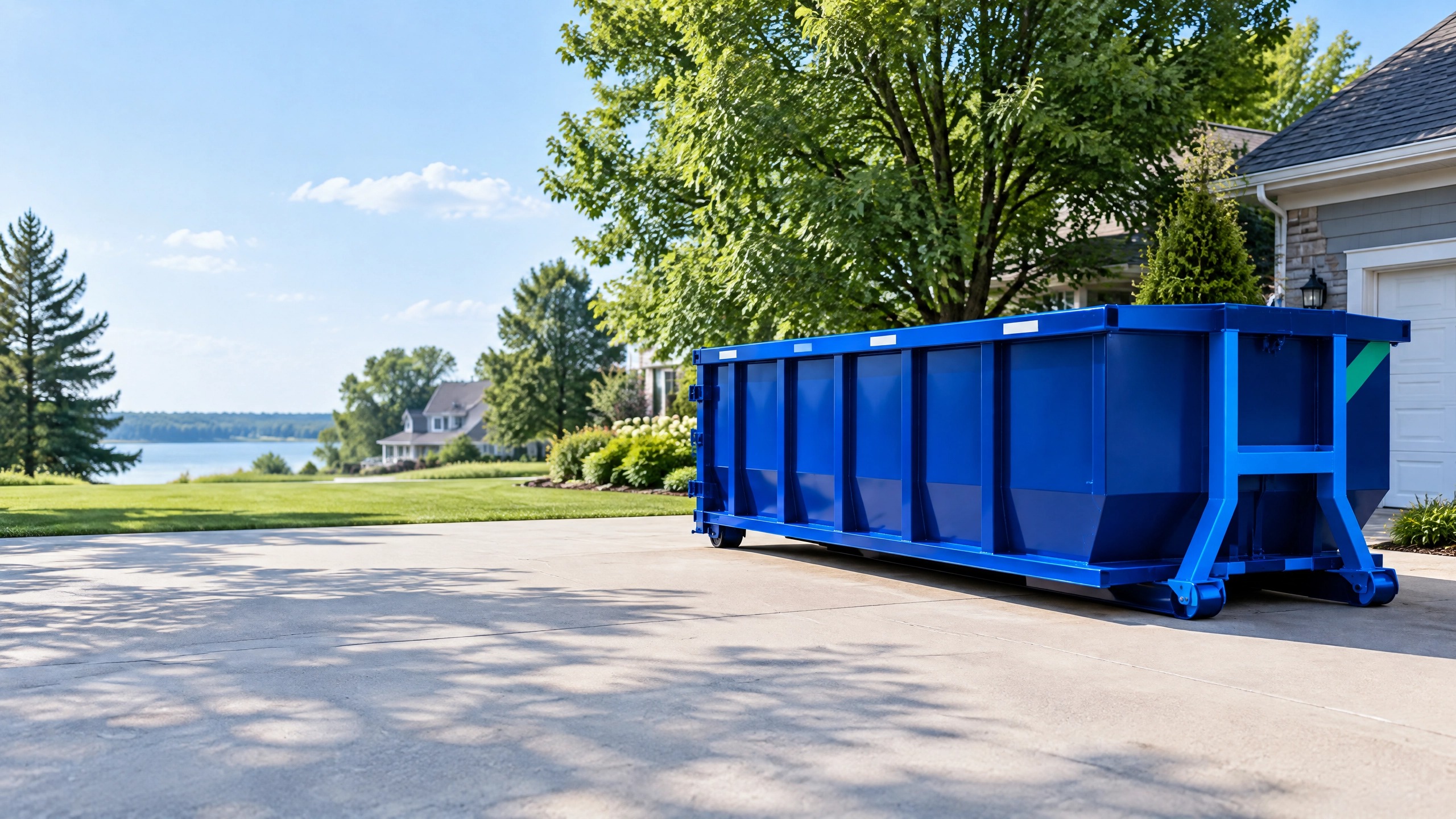
Wondering where to place a dumpster before your rental arrives? For most residential projects, a driveway is the best option because it provides a hard, accessible surface and keeps the container close to the work area. For commercial projects, a paved parking area, loading area, or designated waste-collection zone often works better.
The ideal dumpster location should be level, stable, accessible to the delivery truck, clear of overhead obstructions, and positioned where it won’t block essential access. If you need to use a public street or right-of-way, local permits or approvals may also apply.
Where Is the Best Place to Put a Dumpster?
The best dumpster placement is usually on a flat, hard surface close to where debris is being generated, with enough room for the delivery truck to approach and set down the container safely.
Before choosing a location, consider these five factors:
- Surface: Concrete or asphalt is generally preferable to soft or unstable ground.
- Access: The delivery and pickup truck needs a clear path to the placement area.
- Overhead clearance: Trees, utility lines, roof overhangs, and other obstructions can interfere with delivery.
- Loading convenience: The dumpster should be close enough to the work area to avoid unnecessary carrying.
- Public access: Don’t block sidewalks, fire hydrants, driveways, entrances, utility access, or traffic lanes.
A placement decision should account for the entire rental period—not just whether the truck can drop the dumpster there on delivery day.
Where to Place a Dumpster at a Residential Property
For most homeowners, the driveway is the first place to consider. It is typically close to the house, provides a firm surface, and makes loading debris easier than carrying material across a lawn.
A driveway works particularly well for:
- Home cleanouts
- Garage and basement cleanouts
- Kitchen and bathroom renovations
- Flooring removal
- Roofing projects
- Siding replacement
- Small construction and remodeling jobs
If your driveway isn’t suitable, other private-property locations may work depending on access and ground conditions.
Driveway
Best for: Most residential projects.
A driveway is usually the most convenient location for a roll-off dumpster. Position the container where it doesn’t interfere with garage access or vehicles you need during the project.
Before delivery, remove parked cars and other obstacles from the area.
Side Yard or Paved Private Area
Best for: Properties with limited driveway space.
A paved side yard, parking pad, or other hard-surface area may work when the driveway isn’t available. The key question is whether the delivery truck can safely reach the location.
Check gates, narrow passages, landscaping, retaining walls, and other potential obstacles before choosing this option.
Lawn or Grass
Best for: Situations where no paved option is available and the site conditions allow it.
Grass is generally less desirable than concrete or asphalt because wet or soft ground can become unstable under a heavy container. It can also result in ruts or surface damage.
If you are considering placing a dumpster on grass, discuss the location with the dumpster provider before delivery.
Where to Place a Dumpster for Commercial Projects
Commercial dumpster placement requires more planning because the container must work around employees, customers, deliveries, fire access, loading operations, and other site activities.
For commercial properties, common placement areas include:
| Placement Area | Best Use | Key Consideration |
|---|---|---|
| Parking lot | Retail, office, and property projects | Don’t block customer or employee access |
| Loading area | Construction and renovation | Maintain room for deliveries and equipment |
| Designated waste area | Ongoing commercial waste | Keep collection access clear |
| Private service area | Restaurants and businesses | Avoid blocking utility or service access |
| Construction staging area | Large construction projects | Coordinate placement with site traffic |
For larger jobs, the dumpster should be integrated into the site’s overall material-flow plan. Workers shouldn’t have to carry debris through active vehicle routes or around unnecessary obstacles.
Businesses planning ongoing waste removal can also explore dumpster rental services in Michigan from Rearden Environmental.
How to Choose the Right Dumpster Placement
The best location for dumpster balances accessibility, safety, convenience, and available space.
Use this checklist before confirming your placement:
-
Start With the Work Area
Place the dumpster reasonably close to where debris is being generated.
A dumpster that is 20 feet from the renovation area may be much more efficient than one sitting at the opposite end of a large property. Shorter carrying distances mean fewer trips for homeowners and less unnecessary material handling for crews.
At the same time, don’t place the dumpster so close to a structure that it interferes with doors, windows, equipment, or access routes.
-
Check the Surface
A flat, solid surface is generally the safest choice.
Concrete and asphalt are common placement surfaces because they provide a stable base. Be more cautious with:
- Soft soil
- Muddy areas
- Recently landscaped ground
- Steep slopes
- Areas prone to drainage or standing water
Older asphalt, decorative pavers, and weakened concrete may also require additional consideration because the container and its load can put substantial pressure on the surface.
-
Look Up Before Looking Down
Overhead clearance is one of the easiest placement factors to overlook.
Check the entire area above the proposed dumpster location for:
- Power lines
- Cable or utility lines
- Low tree branches
- Roof overhangs
- Carports
- Building structures
- Other overhead equipment
Roll-off delivery requires the truck and container to move through a vertical operating path. The exact clearance needed depends on the truck and container configuration, so don’t assume that an apparently open driveway will automatically work.
Some dumpster companies cite approximately 15 feet as a minimum for certain residential setups, while other operations require significantly more. Because equipment varies, confirm the clearance requirement with your dumpster provider before delivery rather than relying on a universal number.
-
Keep the Approach Clear
The dumpster itself isn’t the only thing that needs space. The delivery truck also needs a workable approach.
Before delivery:
- Move vehicles out of the way.
- Remove temporary obstacles.
- Keep gates fully accessible.
- Check for tight turns.
- Make sure the driver can reach the drop location.
- Avoid positioning the container where another vehicle must squeeze past it.
A placement spot that looks spacious from above may still be difficult for a large delivery truck to access.
Can You Put a Dumpster on the Street?
Sometimes, but street placement is subject to local rules and may require a permit. Public streets and rights-of-way are regulated differently from private property, so you should check with the applicable municipality before scheduling street placement.
In Michigan, MDOT regulates use of state highway rights-of-way, and work or private activity within those areas can require authorization. MDOT states that businesses and private parties using state highway rights-of-way for operations beyond normal vehicle or pedestrian travel may need a permit.
That does not mean every dumpster placed on every Michigan street follows the same permit process. Local rules vary, and a city, township, county, or road agency may have its own requirements.
If your driveway isn’t suitable and you’re considering a curbside dumpster, check:
- Whether the street is under local or state jurisdiction
- Whether a right-of-way or encroachment permit is required
- How long the dumpster may remain there
- Whether traffic lanes or sidewalks must remain clear
- Whether warning devices or reflective markings are required
- Whether the location affects emergency access
Michigan’s official guidance also makes clear that the agency with jurisdiction over the road may control activities within the public right-of-way.
How Much Space Does a Dumpster Need?
There isn’t one universal space requirement for every dumpster because container dimensions and delivery equipment vary.
Instead of measuring only the dumpster itself, account for three separate areas:
- Container footprint — The physical length and width of the dumpster.
- Truck approach — The space needed for the delivery vehicle to reach and position the container.
- Operating clearance — The vertical and horizontal space needed while the container is being loaded and unloaded from the truck.
For this reason, don’t order a dumpster based solely on whether the box appears to fit in a particular space.
If you’re using a driveway, measure the available area and check the complete approach from the street to the intended drop point.
Where Should You Not Place a Dumpster?
Avoid locations that create access, safety, or property problems.
Common locations to avoid include:
- Under low-hanging power lines or tree branches
- On unstable or heavily saturated ground
- In front of garage doors or building entrances
- Across sidewalks or pedestrian paths
- In front of fire hydrants
- Where it blocks emergency access
- Where it prevents normal vehicle access
- On steep or unstable slopes
- In areas that obstruct loading docks or delivery routes
- Within restricted public rights-of-way without required approval
Commercial properties should also consider employee and customer circulation, delivery trucks, loading zones, and accessibility requirements.
What If You Don’t Have a Good Place for a Dumpster?
If you don’t have an obvious placement area, don’t automatically assume you can’t rent a dumpster.
Start by considering whether you have:
- A second driveway or parking pad
- A paved side area
- A private service lane
- A designated construction staging area
- A commercial parking or loading area
- Another stable location accessible to the delivery truck
If every option has a potential issue, discuss the property with your dumpster provider before delivery. A different container size or placement strategy may solve the problem.
For residential and commercial projects that need a roll-off container, roll-off dumpster rental can provide a practical solution for containing larger volumes of project debris.
Dumpster Placement Checklist
Use this quick checklist before your dumpster arrives:
| Question | What to Check |
|---|---|
| Is the surface stable? | Prefer a firm, level surface |
| Can the truck reach it? | Check the entire approach, not just the drop spot |
| Is there enough overhead clearance? | Look for wires, branches, eaves, and structures |
| Is the area clear? | Move vehicles and temporary obstacles |
| Is it close to the work? | Reduce unnecessary debris-carrying distance |
| Will anything important be blocked? | Check doors, garages, hydrants, sidewalks, and utilities |
| Is it on public property? | Confirm local permit or right-of-way requirements |
| Will the dumpster remain accessible? | Consider the entire rental period |
Real-World Placement Examples
Example 1: Garage Cleanout
A homeowner cleaning out a garage has a clear, level driveway with no overhead obstructions. The best location is usually the driveway, positioned so the dumpster doesn’t block the garage door.
This minimizes the distance between the garage and dumpster while keeping the delivery area accessible.
Example 2: Kitchen Renovation
A homeowner is remodeling a kitchen but needs daily access to the garage. Instead of placing the dumpster directly in front of the garage, a different portion of the driveway or another suitable private area may work better.
The best location isn’t necessarily the closest possible location. It’s the closest practical location that doesn’t interfere with the rest of the project.
Example 3: Commercial Renovation
A retail business is replacing flooring while remaining open to customers. A dumpster placed directly in front of the main entrance would create unnecessary problems.
A private loading or service area may be a better option, provided the delivery truck can access it and the placement doesn’t interfere with deliveries, employees, customers, or required access routes.
Proper Dumpster Placement Ensures Your Project Goes Unhindered
Knowing where to place a dumpster can make debris removal safer, easier, and more efficient. For most residential jobs, a suitable driveway is the natural starting point; commercial projects may benefit from a designated parking, loading, or waste-collection area.
Before delivery, focus on surface stability, truck access, overhead clearance, loading convenience, and local placement rules. If you’re unsure whether your property can accommodate a dumpster, discuss the placement with Rearden Environmental before scheduling delivery.
At Rearden Environmental, we offer dumpster rental services in Michigan offering roll-off dumpster rental for residential and commercial projects. We don’t just provide dumpsters but guide you in choosing the right size based on your project and placement requirements.
Frequently Asked Questions
Where is the best place to put a dumpster?
For most residential projects, a flat, stable driveway is the best location. For commercial projects, a paved parking lot, loading area, or designated waste area may be more appropriate. The location should have adequate truck access, overhead clearance, and space around the container.
Can I put a dumpster on my lawn?
Sometimes, but grass and soil are generally less reliable than a hard, stable surface. Wet or soft ground can create ruts or allow the container to shift or settle. Discuss lawn placement with the dumpster provider before delivery.
How do I know if my driveway has enough clearance?
Check the entire delivery path for overhead wires, tree branches, roof overhangs, carports, and other obstructions. Because required clearance varies by dumpster and delivery equipment, confirm the provider’s specific requirements before delivery.